
Producer Pay Forecast: October 7, 2026
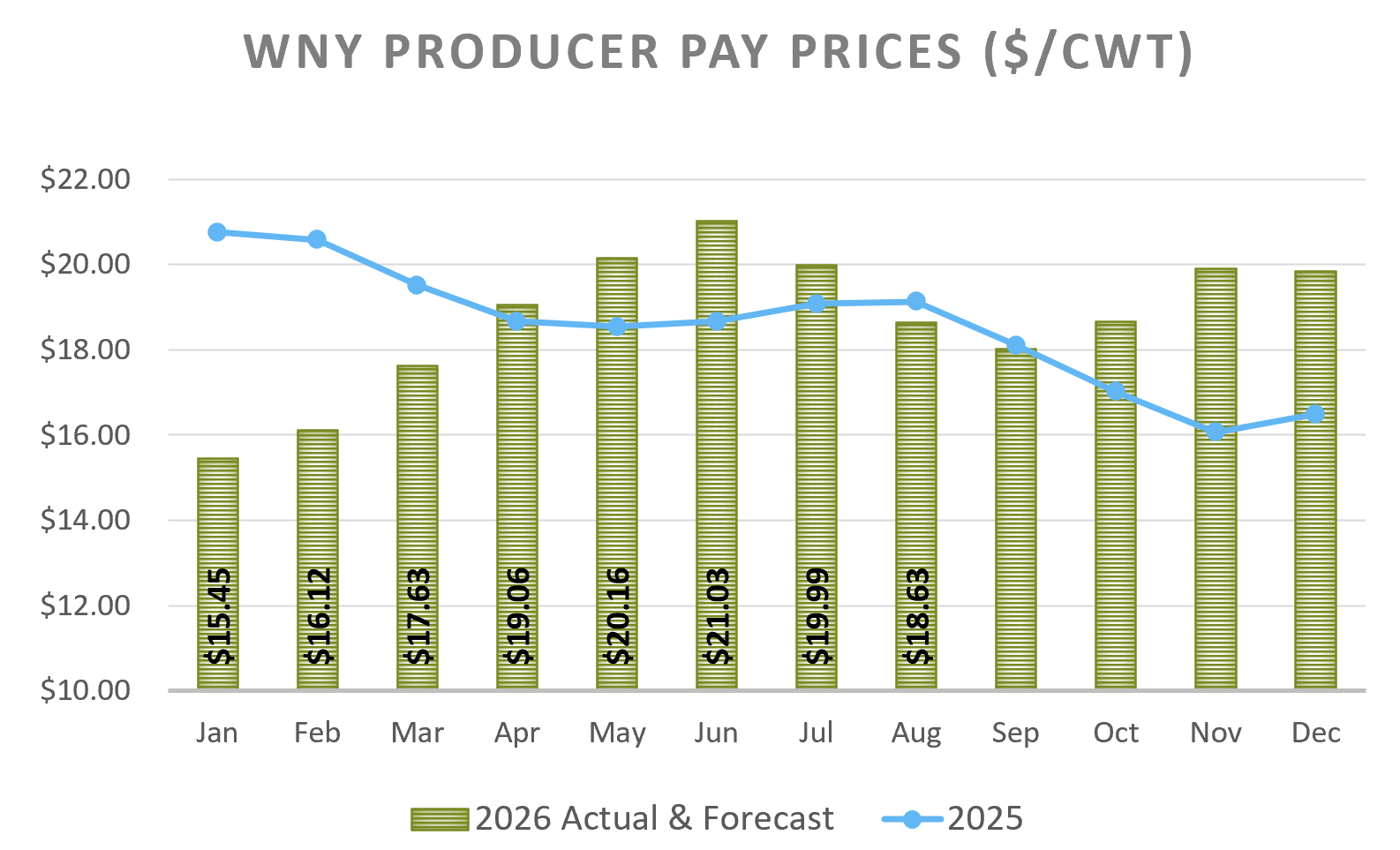
Currently the September blend price is estimated around ~$18.02/cwt, with some improvement expected throughout the remainder of the year. That improvement is being supported largely by stronger nonfat dry milk (NFDM) and dry whey values, while cheese and butter prices remain suppressed. We are seeing support in portions of the dairy complex, but there has not been a broad recovery across all products.
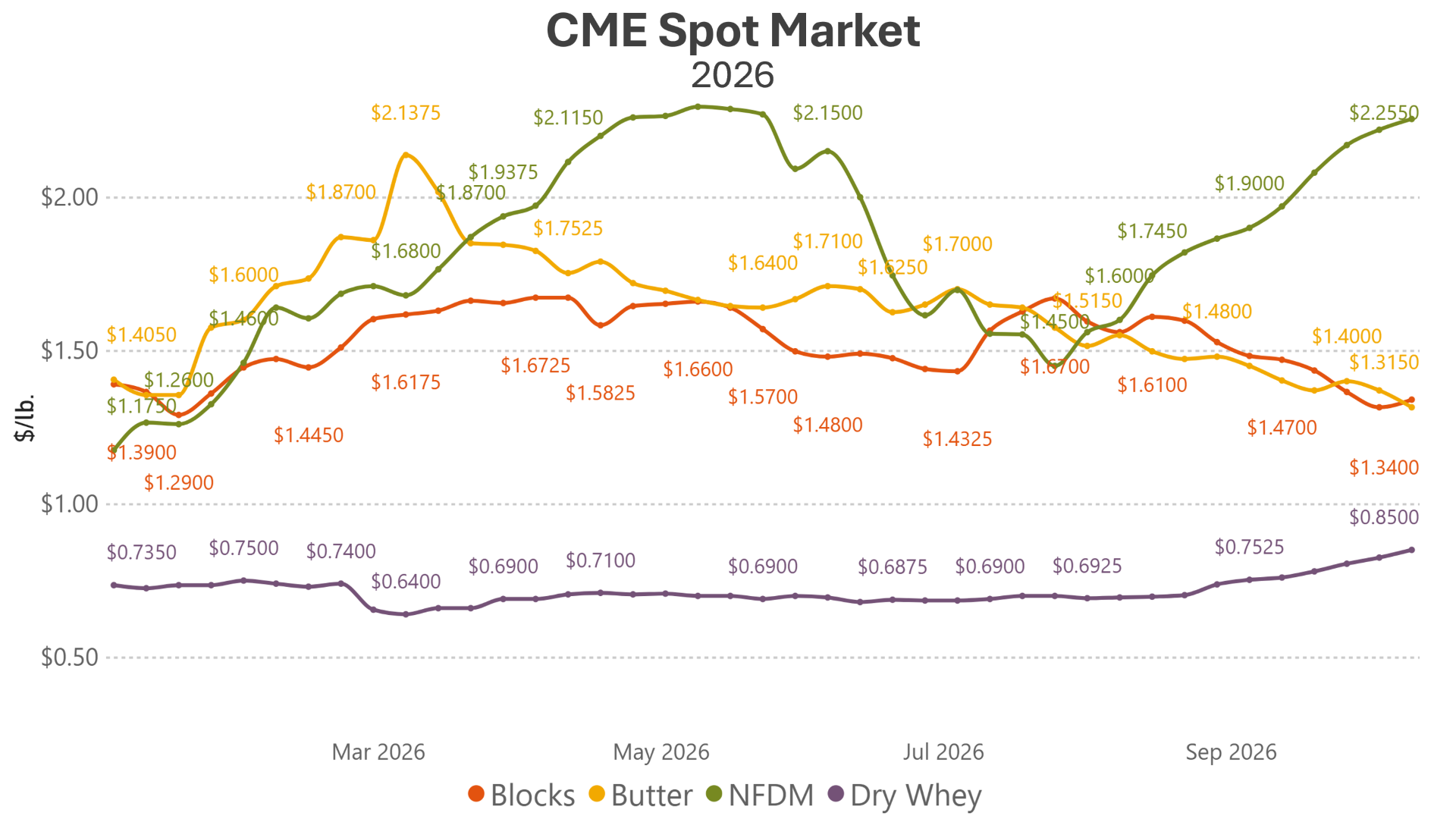
At the CME spot market, blocks fell to $1.2700/lb. (9/30), their lowest level since the pandemic, before recovering slightly and ending at $1.3400/lb. (10/7). Butter continued its decline, landing at $1.2900/lb., while NFDM climbed to $2.2550/lb., and dry whey reached $0.8500/lb. (10/7).
Looking further ahead, my current 2027 forecast estimates the annual average for Class I at $23.03/cwt, Class II at $20.00/cwt, Class III at $17.01/cwt, and Class IV at $19.15/cwt. The estimated annual average blend price is ~$19.50/cwt for the year. The projected spread between class prices remains significant, and changes in commodity prices, product mix, and Federal Order utilization are likely to create meaningful movement in the monthly blend price throughout 2027.
One challenge in the current market is that strong dairy demand does not necessarily translate directly into stronger producer pay prices. Milk continues to move into a wider range of products, including specialty cheese and higher-value protein products that are not directly represented in the NDPSR commodity prices used in Federal Order pricing formulas. As the product mix continues to evolve, the value being generated across the dairy industry and the values that ultimately drive regulated milk prices do not always move together.
The latest USDA Dairy Products report reinforces the split. Total cheese production in August was up 1.4% year-over-year (YOY), but cheddar production was down again, 0.9% below prior year. Italian-style cheese production grew 3.7% in August, while cottage curd production rose 21.1%, dry whey production increased 8.2%, and NFDM production was 9.6% higher (YOY). Despite the increased production, NFDM stocks were down 3.6% over the same period due to the continued rising demand for high protein products.
There are additional sources of uncertainty heading into 2027. Consumers continue to face higher household costs and an uncertain economic environment, while U.S. dairy increasingly relies on exports and international demand. Global conflicts, energy and transportation costs, currency movements, and changing production conditions among major dairy exporters could create further volatility. These factors could swing markets in either direction and make the timing and magnitude of price changes difficult to predict.
For now, the forecast reflects some improvement in producer pay prices, supported primarily by stronger powder and whey demand, while recognizing that dairy markets remain uneven.
If you have any questions, reach out to Allee Coombe at acoombe@uncdairy.com


